
Recognizing strike quality is one of the hardest skills in numismatics. Two coins with the same grade often act like they belong to different markets because one carries full design detail, and the other shows softness from the moment it was made. Many collectors rely on a coin scanner to quickly classify a coin, yet strike remains a physical trait that no camera model can read with precision.
The real difference hides in thin lines, small gaps, and tiny relief zones that appear only when the die strikes the metal with full force. A Jefferson nickel with true Full Steps behaves differently from one with broken steps. A Mercury dime shows clear separation between the bands or loses the premium entirely. A Roosevelt dime with a full torch shows complete vertical and horizontal lines. A Standing Liberty quarter gains value when Liberty’s helmet is sharply defined.
Understanding these traits gives collectors the ability to judge quality without guessing. It also explains why some coins rise far above the average price for their grade.
Why Strike Indicators Matter More Than Beginners Expect
Strike shapes the design at the moment of minting. Wear appears later, but strike defines the foundation. A weak strike can look like circulation wear. A strong strike can lift a mid-grade coin above expectations.
Collectors value sharp detail because it shows how the die and planchet interacted. When the strike is full, the coin displays the design exactly as intended. When the strike is weak, high-point elements flatten or blend even before the coin leaves the mint.
The market follows this logic. Coins with full indicators sell faster, attract more competition, and create stronger premiums. Coins with soft detail, even at higher grades, often fall to the lower end of the price range.
Strike indicators act as proof of detail. They help collectors separate normal examples from premium ones within the same grade, date, and mint.
What Strike Really Measures
Strike does not measure wear. It measures the force of the die and the sharpness of the design transfer.
Several traits reveal strike strength:
- The integrity of fine lines and small gaps
- The separation of layered design elements
- The clarity of high-point details
- The structure of recessed areas
When these details appear sharp, the coin shows a strong strike. When they appear muted, the strike was weak. Tone, surface marks, and luster come later. Strike forms the base of value long before grading begins.
Why the Market Rewards Full Indicators
Collectors compete for coins that show complete detail. Full indicators prove that the coin received a strong, clean strike. This makes the piece more desirable even when the grade stays moderate.
A Jefferson nickel in MS64 with Full Steps often outsells an MS65 without them. A Mercury dime with Full Bands can bring a strong premium at XF, while an AU example with broken bands may sell lower. The same rule applies to Roosevelt dimes and Standing Liberty quarters.
Strike separates coins into categories. It creates its own price tiers. Understanding these tiers helps the collector read the market accurately and avoid overpaying for weak examples.
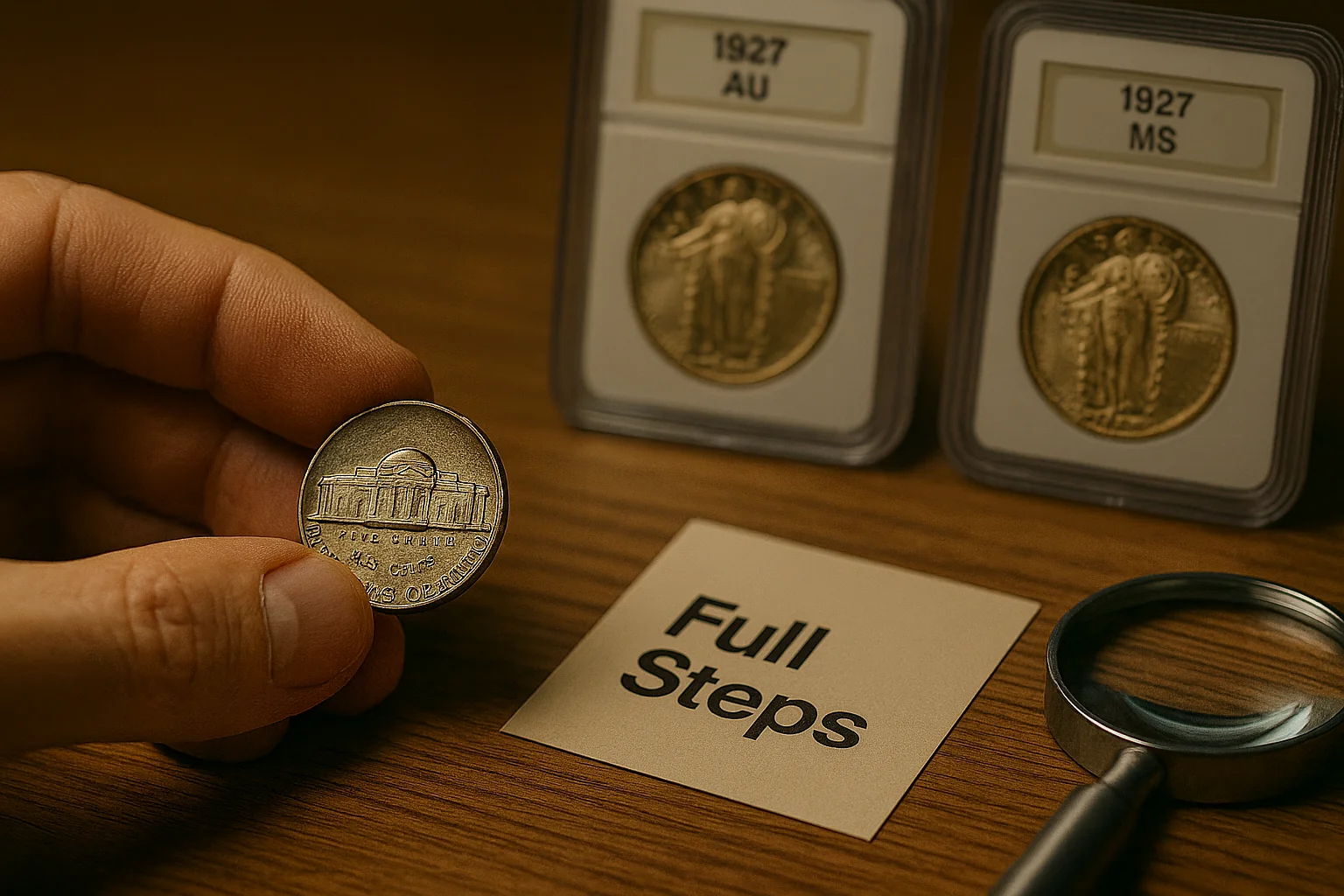
Full Steps: Reading the Jefferson Nickel Correctly
Jefferson nickels rely heavily on strike quality because the Monticello steps are thin, closely spaced, and easily distorted. Full Steps require uninterrupted lines across the staircase. Even one mark, bridge, or blend removes the designation.
What Full Steps indicate
A Jefferson nickel with Full Steps shows:
- Complete separation of the step lines
- Clean vertical pillars
- Strong pressure across the center of the reverse
The steps sit in a strike-sensitive area. Any softness in the die or obstruction on the planchet weakens the result. Bag marks also break the lines, so the coin must show both a strong strike and clean preservation.
Why collectors pay more
FS nickels represent a small share of the population for many dates. Some years have a natural strike weakness across entire mint runs. In these cases, a single FS example becomes a prize.
Because of this, FS coins sell far above non-FS pieces of the same grade.
Full Bands: Reading the Mercury Dime Reverse
The bands around the fasces are thin. They sit on a round object with curved relief, so the die must hit with full force for the separation to show clearly.
How to identify Full Bands
Look for clear horizontal separation between the upper and lower bands. Each band must show a clean break from the one above or below it. Blended bands or soft edges disqualify the designation immediately.
Why bands matter
Full Bands prove the coin was struck with strong pressure. Many Mercury dimes show partial softness at the center of the reverse, especially from worn dies.
Collectors who chase strike detail pay premiums for coins that show both complete bands and clean surfaces. Even small friction does not damage the premium as much as broken bands.
Full Torch: Roosevelt Dimes and the Value of Small Lines
Roosevelt dimes use a different indicator. The torch on the reverse carries a vertical set of lines and two horizontal bands. To achieve Full Torch, all vertical lines must be complete, and both the upper and lower horizontal bands must show clear separation.
Reading the indicator
True Full Torch examples show:
- Crisp vertical lines with no blending
- Defined horizontal bands
- Uniform strike pressure in the center of the die
The torch is small. Any weakness during minting or any small mark can break the pattern. Because of this, Full Torch coins form a small part of the population.
Why prices differ
Common-date Roosevelt dimes can show strong spreads between regular MS examples and Full Torch pieces due to rarity in full detail. Even a modest grade can outperform higher-graded examples when the torch is complete.
Full Head: Standing Liberty Quarters and Their Strike Challenge
Standing Liberty quarters are known for inconsistent strike quality. Liberty’s head sits in a high-point zone, and the detail fades easily unless the die strikes cleanly. Full Head requires sharp, separate details across the helmet, facial outline, and hair structure.
Recognizing Full Head
A Full Head example shows:
- A defined helmet rim
- Visible hair strands
- Clear separation between facial and helmet contours
Weak head strikes appear flattened or blurred even when the coin is technically Mint State.
Market effect
Full Head pieces act like a different tier. A common date in Full Head can outperform scarcer dates without the designation. This is why experienced collectors check the strike before the grade.
Why These Indicators Change Auction Results So Strongly
Auction platforms show clear spreads between coins that carry full indicators and those that do not.
Reasons include:
- Rarity within the grade
- Strong first impression
- Increased demand from specialists
- Better long-term liquidity
Collectors often compete aggressively for coins with perfect strikes because the supply is limited. Weak strike examples may sit unsold even with higher technical grades. This pattern repeats across decades, mints, and metal types.
Can Apps Read Strike Quality Today? The Real Limitations
Apps help with classification, but not with strike evaluation. A coin value app estimates typical prices for the type and confirms the basic characteristics. This helps frame the expected range. It does not read strike detail, surface texture, or the depth of fine lines.
The app recognises the design, the inscriptions, the metal, and the version. It cannot judge Full Steps, Full Bands, Full Torch, or Full Head because these depend on relief depth, not design shape.
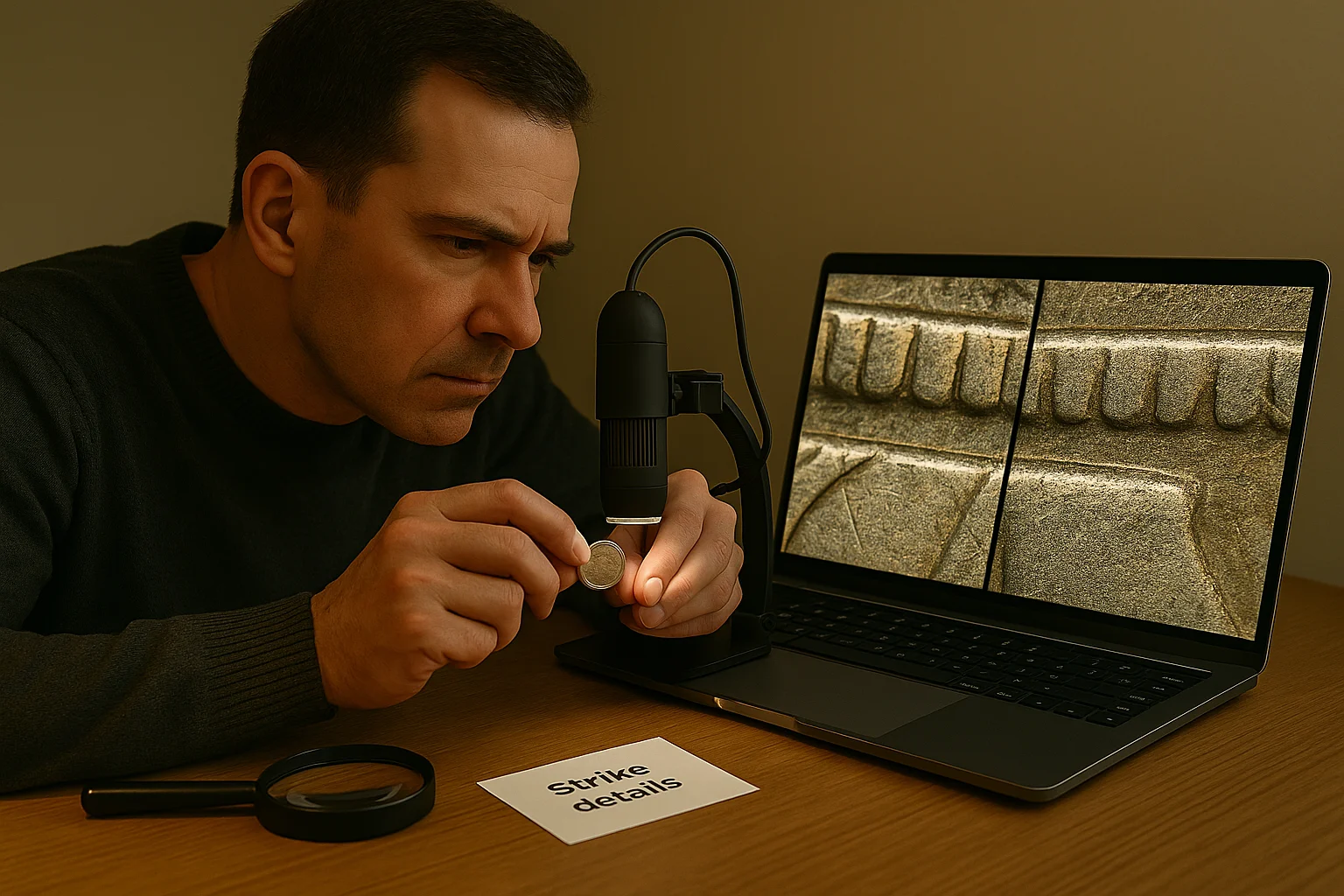
Apps rely on visual matching. Strike indicators rely on microscopic structure. This is why digital recognition cannot replace manual inspection under controlled light.
Coin ID Scanner supports the earliest stage by confirming the correct type and verifying key parameters. Its role ends once strike evaluation begins. Only physical inspection reveals whether the coin carries a true strike premium.
Where Apps Fit Into This Workflow
Apps help only at the starting line. They verify:
- Type
- Metal
- Diameter
- Basic variety
- Estimated value
They show the typical range for the type. They do not interpret the specimen’s strike.
This division keeps the process stable. Apps classify. Collectors evaluate. Auctions confirm.
How to Examine Strike Correctly Without Doubts
Collectors can read strike strength by following a simple method:
- Use soft, even light.
- Tilt the coin slowly to reveal high-point details.
- Study the fine lines and recessed areas.
- Compare with verified examples of full indicators.
- Check for marks that break key lines.
- Review auction images for the same date and mint.
- Rank the strike independently from the grade.
This process shows whether the coin sits in the premium category or follows the ordinary tier.
When Strike Matters More Than the Grade
Strike influences demand faster than small grade differences. Examples:
- A sharply struck AU58 nickel with Full Steps often outperforms a dull MS63 without steps.
- A Full Bands Mercury dime in XF can bring stronger attention than an AU example with weak detail.
- A Full Head Standing Liberty quarter in VF can sell above expectations because collectors chase the indicator more than the grade.
These patterns show why strike analysis should come before grade interpretation.
Bringing Everything Together
Understanding strike indicators turns complex price behaviour into predictable patterns. Strike shapes the way the market reacts to identical dates. Full Steps, Full Bands, Full Torch, and Full Head form premium tiers. These premiums apply across grades and even across different eras.
A coin identifier app contributes to the first step by confirming the type. The rest depends on careful inspection, clean lighting, and comparison with real sales. Collectors who master strike evaluation read the market more clearly and avoid paying high prices for weak examples. They also spot premium pieces quickly, even when labels and grades look ordinary.