Every mark, tone, and edge has a role in the final grade.
The Professional Coin Grading Service Assessment begins with four core factors that build the final score.
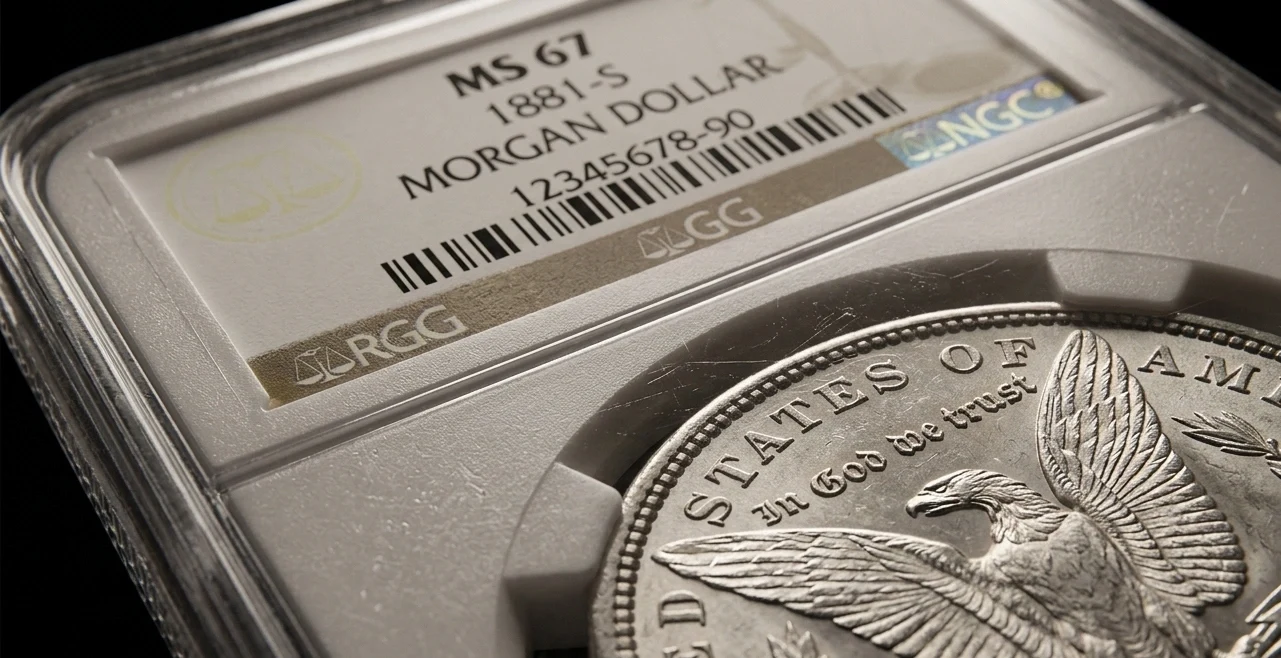
Experts distribute their focus across these areas according to industry-standard ratios.
Visual Analysis Breakdown:
- Strike Quality → sharpness of the design’s finest details
- Surface Preservation → absence of marks, scratches, or wear
- Mint Luster → intensity of light reflection from the metal flow lines
- Eye Appeal → overall aesthetic harmony, including natural toning
Combined, these elements dictate a coin’s position within the grading hierarchy.
Magnification tools with 5x and 10x power are the baseline requirements for every initial inspection.
Sheldon Scale: Digital and Physical Interpretation
The 70-point system provides a specific description for every stage of metal wear.
Small one-point differences in top categories can trigger price shifts of several thousand percent in 2026.
| Numerical Grade | Technical Label | Physical Condition Description |
| 1-3 | Poor / Fair | Heavy wear, designs are barely visible outlines |
| 4-12 | Good / Fine | Main contours present, all text is readable |
| 20-45 | Very Fine / XF | Moderate wear on the highest design points |
| 50-58 | About Uncirculated | Slight traces of friction, original luster remains |
| 60-70 | Mint State | Zero traces of circulation, original surfaces |
Achieving an MS70 grade is considered nearly impossible for coins over fifty years old.
Statistics from leading services show that less than 0.01% of all submissions receive a perfect score.
Technical Standards for Valuation
Correct grading requires comparing a coin against its original factory specifications.
Modern labs in 2026 utilize high-precision laser scales to detect any metal loss.
| Coin Type | Primary Metal | Standard Mass | Tolerance |
| Mercury Dime | 90% Silver | 2.50 grams | 0.06 grams |
| Washington Quarter | 90% Silver | 6.25 grams | 0.19 grams |
| Morgan Dollar | 90% Silver | 26.73 grams | 0.25 grams |
Digital calipers verify the diameter to ensure the piece is not a modern counterfeit.
Edge thickness is scrutinized for signs of filing or mechanical alterations.
Improper use of a wrench to remove coins from homemade holders often deforms these critical parameters.
Surface Damage and Weighted Penalties
Flaws are classified by their severity and their location on the coin’s surface.
Marks in the central “focal zones” of a portrait lower a grade more than edge defects.
Damage Source → Grading Result:
- Deep Scratch on Face → drop from MS65 to MS62
- Field Mark behind Head → 1-point deduction
- Corrosion Pitting → denial of a numerical grade
- Smooth Lettering → reclassification to “Circulated” status
Cleaning coins with household chemicals at home destroys their numismatic value instantly.
Acidic solutions leave microscopic grooves on the metal that are easily spotted under a microscope.
Such pieces receive a “Details” label, making them ineligible for standard investment pools.
Impact of Encapsulation on Market Value
Placing a coin in a sonically sealed plastic “slab” fundamentally changes its financial profile.
Buyers in 2026 rarely accept expensive rarities without PCGS or NGC verification but with the free coin scanner.
- Transaction Security: Verification confirms metal purity and the absence of repairs.
- Liquidity: Certified coins sell up to 4 times faster than “raw” equivalents.
- Protection: Airtight holders prevent further oxidation of silver or copper.
Growth for coins graded MS66 and higher has averaged 7% annually over the last decade.
Uncertified coins often trade at a discount because of the uncertainty surrounding their true state.
The Multi-Level Lab Workflow
Modern grading algorithms eliminate individual preference from the final verdict.
Minimums of three experts examine every coin before a grade is finalized.
- First Expert: Handles authentication and sets an initial condition range.
- Second Expert: Independently assigns a score without seeing the first opinion.
- Final Judge: Resolves any discrepancies and issues the definitive grade.
Signs of soldering or altered dates lead to immediate disqualification at this stage.
X-ray analysis confirms the metal mix without ever touching or scratching the surface.
Specialty Designations and Premiums
Numerical scores are often supplemented by specific strike designations.
These labels highlight the highest quality examples of a particular production run.
- Full Bands (FB) → complete detail on the reverse of silver dimes
- Full Head (FH) → crisp strikes of Liberty’s head on quarters
- Deep Cameo (DCAM) → mirror-like fields with frosted designs on proof coins
- Red (RD) → preservation of original copper color on cents
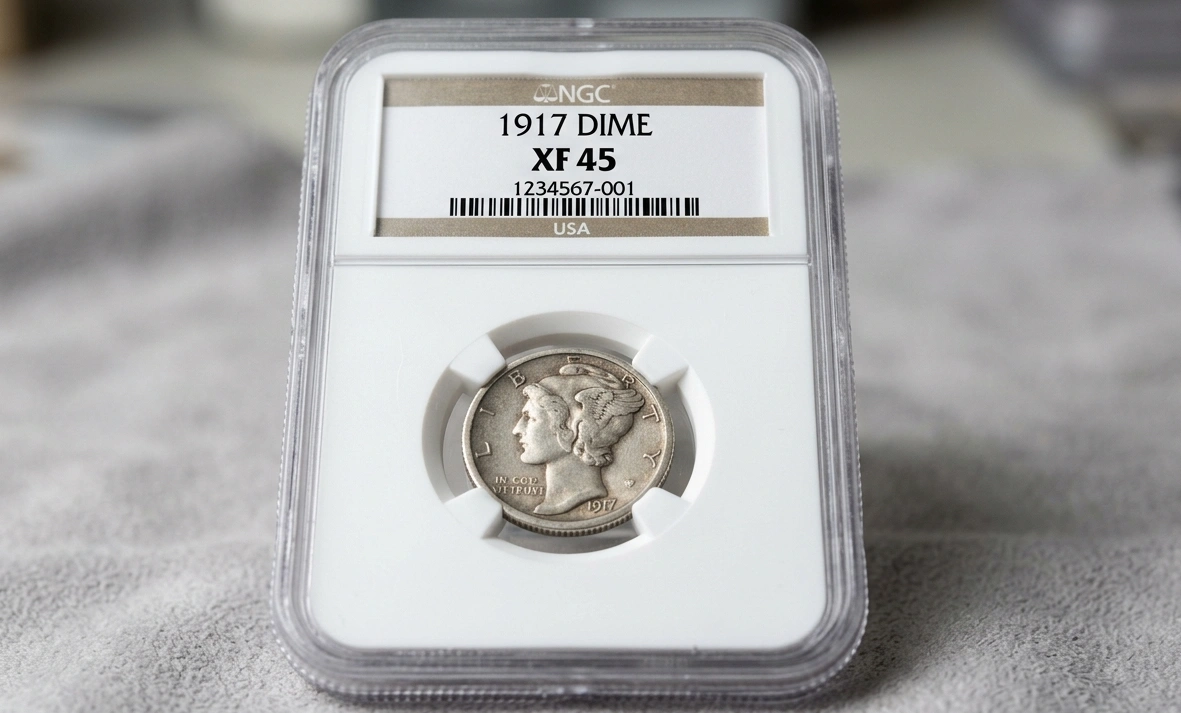
A “Full Bands” designation on a 1917 dime can move the price from $500 to over $4,500.
Lacking these markers at high numerical grades significantly reduces a coin’s appeal to elite collectors.
2026 Grading Economics: Costs vs Returns
Deciding to submit a coin must be a mathematical decision based on potential profit.
Service fees in 2026 vary based on the value and rarity of the submission.
| Service Tier | Cost per Unit | Turnaround Time |
| Modern Issues | $22 | 30 Days |
| World Classics | $45 | 45 Days |
| Gold Rarities | $150 | 15 Days |
| Walk-through Express | $350 | 5 Days |
Shipping and insurance typically add an extra $30–$50 to the final bill.
Submitting coins valued under $100 is generally considered a poor financial move.
The price increase from certification must outweigh all associated operational costs.
Price Trends for Certified Specimens
Data from 2021 to 2026 highlights a strong preference for high-grade survivors.
Lower grades are currently seeing stagnation or decline due to an oversupply of average material.
- Grades MS67+: 12% annual growth
- Grades MS64-MS66: 4% annual growth
- Grades Below MS60: Fluctuations matching basic inflation
Record 2025 sales reached $150,000 for a single rarity in MS68 condition.
An MS65 version of that same coin sold for $12,000, proving that value growth is not linear.
Surface Chemistry and Toning Impacts
Condition depends heavily on the chemical reactions occurring at the metal’s surface.
Silver and copper are highly reactive to oxygen and environmental pollutants.
- Thin Oxide Film: Protects the metal from deeper damage while preserving luster.
- Artificial Toning: Attempts to hide flaws using chemical washes.
- Natural Patina: Forms over decades and often improves the “Eye Appeal” score.
Experts detect fake toning by looking for unnatural color transitions.
Coins with “enhanced” surfaces are returned with a “Questionable Color” label.
High-Tech Forgeries and Detection Logic
Advancing minting technology in 2026 forces grading services to adopt new defenses.
Counterfeiters now use sophisticated machinery to create nearly perfect silver and gold fakes.
- Edge Analysis: Verification of side-alignment and reeding patterns.
- Metal Spectrum Test: Scanning for trace impurities not found in early 20th-century tech.
- Die Pairing: Matching cracks and tool marks against known authentic examples.
Identifying a fake during the grading process prevents an investor from losing their entire capital.
The cost of a mistake when buying an uncertified rarity is often 100% of the purchase price.
Grading Service Demand Demographics
Certification is no longer just for professional coin dealers.
The 2026 landscape shows a diverse group of users submitting coins for evaluation.
- Private Investors: 55% of all orders
- Museums and Funds: 15% of all orders
- Heirs and New Owners: 20% of all orders
- Trade Houses: 10% of all orders
Rising interest in numismatics as a “safe haven” asset has led to backlogs in service centers.Digital archives allow anyone to verify a certificate number via a mobile free coin appraisal app instantly.